
Hello ExamSeekers,
During the past few weeks, I’ve been posting about the B1: Preliminary exam, previously known as Cambridge English: Preliminary, and the Preliminary English Test (PET).
B1 Preliminary is an intermediate-level qualification designed for learners who have mastered the basics of English and now possess practical language skills for everyday use. It targets Level B1 of the Common European Framework of Reference (CEFR).
As you know, the B1 Preliminary Reading Exam is divided into six parts:
- Part 1 – Multiple Choice;
- Part 2 – Matching;
- Part 3 – Multiple Choice;
- Part 4 – Gapped Text;
- Part 5 – Multiple-Choice Cloze;
- Part 6 – Open Cloze.
Today, let’s clarify the second part of the B1: Preliminary – Reading Exam:

PART 3 – Multiple Choice
The third part, for me, is the simplest because there is no trick. It is actually very straightforward since you read a text for comprehension and choose the correct answer. There is no straighter way to go. In this case, specifically, you have to read a longer text – differently from the previous ones – for detailed comprehension, gist, inference, global meaning, and the writer’s attitude and opinion.
Look at the sample text:
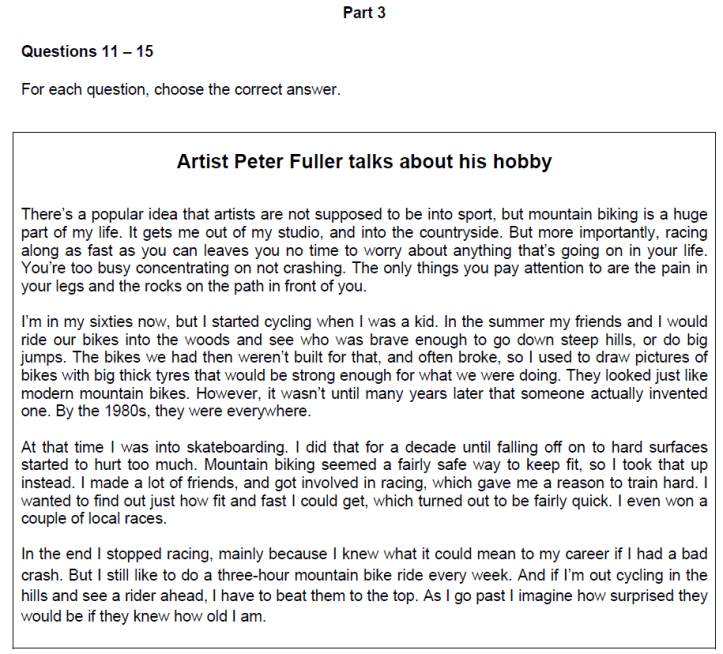
Then, you choose one of the provided options, as you can see below:

There are two ways of going through this task:
- Read the whole text, then go through the option-answers.
- Check the options, then look for the answers in the text.
I prefer the second option because you lose less time in the exercise, and you usually don’t waste too much time and effort going back and forth in the text.
TIP n.º 1
Can you see that there are four (4) paragraphs in the text and five (5) questions? Well, the first four questions are almost always directly linked to the four paragraphs above. So, I usually read the four alternatives to the first question and then read the first paragraph to find the correct option.
TIP n.º 2
I usually read A, B, C, and D, and I underline what I consider essential aspects because if I read a paragraph of the text and get confused, I go back to the options and check what I underlined without having to read the complete sentence. It’s more focused.
TIP n.º 3
If you read the alternatives and then the text, and you don’t have any clue. Eliminate the options you are sure don’t answer the questions accurately. There are usually two (2) alternatives that don’t fit. It gives you more clarity, and you stop reading options that won’t help you at all.
Now, let’s try to answer question 1 using the tips.
11. Peter enjoys mountain biking because
A) it gives him the opportunity to enjoy the views.
B) he can use the time to plan his work.
C) he is able to stop thinking about his problems.
D) it helps him to concentrate better.
Paragraph 1:
There’s a popular idea that artists are not supposed to be into sport, but mountain biking is a huge part of my life. It gets me out of my studio, and into the countryside. But more importantly, racing along as fast as you can leaves you no time to worry about anything that’s going on in your life. You’re too busy concentrating on not crashing. The only things you pay attention to are the pain in your legs and the rocks on the path in front of you.
- First, I read the alternatives and underlined essential aspects.
- Then, I read the first paragraph and underlined what I thought would connect to the possible answers.
- After that, I re-read my underlined options, and I eliminate the alternatives that don’t correspond. In this case A and B because there is no correlation whatsoever.
It leaves me with alternatives D and C.
Using elimination, you could finally eliminate D, because in the text, Peter mentions that mountain biking makes him focus on the pain and the path, which could be a way of better your concentration, but “more importantly,” it “leaves you no time to worry about anything.” So, the correct alternative is the letter C, because it helps him not to worry about his problems.
As I told you, this is a very straightforward exercise. You read, and you answer.
Now you might ask me: “What about question n.º 5?” Well, as I mentioned, there are five questions (5 possible marks) to 4 paragraphs; how can I solve that?! Usually, question number 5 is not related to a specific paragraph but to the whole text. It might be a general comprehension of it, a correlation to the title, or even your inference of what the writer intended to say. Therefore, you must read the whole text once to understand and answer correctly.
Anyhow, it is still a simple read, and choose the correct alternative text.
Now, try answering the other questions. When you’re done, check the end of the post to get your answers.
If you still have questions, please comment in the comment section below, and I will help you 🙂
————x————
That’s it for today! Please like the post and follow the blog on:
You can also listen to this post on Spotify!!!
Have a great week,
Patricia Moura

Make a one-time donation
Make a monthly donation
Make a yearly donation
Choose an amount
Or enter a custom amount
Your contribution is appreciated.
Your contribution is appreciated.
Your contribution is appreciated.
OBS: All samples provided by Cambridge English.
Answer Key
11. C
12. C
13. D
14. A
15. B